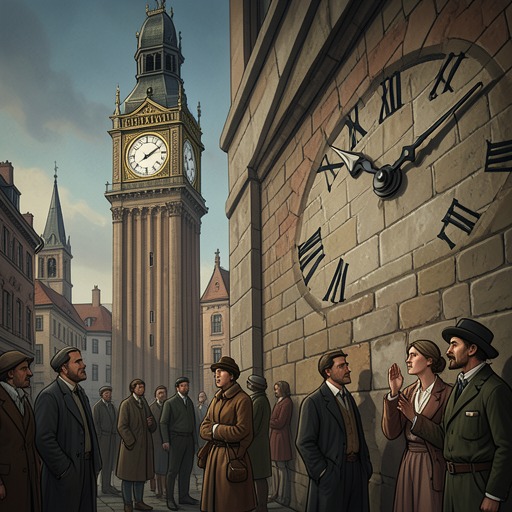
Big Ben
Mrs DallowayBig Ben is more than a landmark in Mrs. Dalloway: its voice measures the June day while repeatedly entering the private thoughts and movements of people across London. Its chimes join a city of separate lives without erasing their differences, turning public clock time into a recurrent pressure on memory, feeling, and action.
The Clock in the City
Clarissa Dalloway has lived in Westminster for more than twenty years, and she feels a hush and suspense before Big Ben strikes, even amid traffic or on waking at night. The pause may be associated with her heart, which others say has been affected by influenza, but the passage leaves the sensation poised between bodily experience and the city’s measured time. When the hour sounds, its musical warning gives way to an irrevocable stroke; the circles of sound seem to dissolve into the air.
The clock’s voice belongs to a London whose movement Clarissa loves. Crossing Victoria Street, she takes in carriages, motor cars, omnibuses, vans, street sellers, bands, and the sound of an aeroplane. The hour does not remove her from that bustle: it passes through it, making the shared city audible even as her response remains personal. Her sense that people love life, whatever their circumstances, unfolds alongside this mixture of public noise, motion, and time.
Chimes as Scene Divisions
Big Ben’s strikes repeatedly set the measure for encounters. When Peter Walsh meets Elizabeth Dalloway at Clarissa’s house, the half-hour sounds between them with unusual force. Peter immediately turns to Elizabeth, says goodbye to Clarissa without looking at her, and leaves. Outside, he keeps time with the direct sound of the half-hour. The chimes accompany his departure, but they also frame his return to the street and the thoughts that follow: he reflects on Clarissa’s parties and on the fact that she refused him.
At half-past eleven, St. Margaret’s answers the public clock in the imagined voice of a hostess who finds her guests already in the drawing room and insists she is precisely on time. The passage makes the clock’s authority social as well as mechanical: its hour can be heard as a standard against which arrival and lateness are judged. Yet the personified church’s voice is reluctant to impose that standard, complicating the apparent certainty of the time it announces.
At noon, Big Ben’s stroke travels across northern London and mingles with the sounds of other clocks, clouds, smoke, and seagulls. The novel places this public signal beside two simultaneous routines: Clarissa lays her green dress on her bed, while the Warren Smiths walk down Harley Street for their appointment with Sir William Bradshaw. The same hour reaches different lives and appointments, but does not make their experiences identical. It establishes simultaneity across the city while leaving the inner meaning of each scene distinct.
The Hour and Private Experience
Big Ben also gives solemn weight to small movements. When it strikes the half-hour as Clarissa watches an elderly neighbour move away from her window, the sound seems to draw the woman back into ordinary life and make her passage through the room momentous. Clarissa imagines the stroke as a force that impels the neighbour to go, then follows her with her eyes as she moves among the furniture. The clock does not explain the woman’s private world; instead, its public measure sharpens Clarissa’s awareness that the neighbour remains separate and largely unknowable.
The hour also interrupts Clarissa’s reflections inside her own home. At three, the striking clock fills her drawing room as she is annoyed by a note about Ellie Henderson’s wish to attend the party and by Elizabeth’s time with Doris Kilman. Richard arrives with red and white roses, but cannot bring himself to say that he loves Clarissa in so many words. She understands his feeling without his saying it. The chime marks the arrival and gives the scene a fixed point in the afternoon; the unspoken affection, however, passes between the couple by a route no clock can measure.
Public Time and the Ending
The prolonged evening created by Mr. Willett’s summer time is new to Peter after his return from India. The altered schedule extends the daylight, and he finds the light and the young people enjoying their free hours encouraging. His response shows that the novel’s temporal order is not simply natural or timeless: official adjustments can change how long the day seems, what people can do after work, and how the city appears to a returning observer.
Near the end of the evening, Big Ben strikes while Clarissa watches an elderly woman across the way. The neighbour quietly prepares for bed and puts out her light. Meanwhile, the party continues in the drawing room, and Clarissa has learned that a young man has killed himself. The clock’s hour accompanies her recognition of the death, her sense of an affinity with the stranger, and her eventual decision to return to the guests. Its strokes do not resolve the distance between the dead man, the woman across the street, and the party; instead, they hold these different lives within one passing night.
Across the novel, the clock’s regular recurrence contrasts with time as it is privately endured: an hour can be an appointment, an interruption, a social deadline, or the occasion for a memory to surface. By sounding across separate scenes and districts, Big Ben supplies a common temporal frame, while the characters’ sharply different responses preserve the plurality of their inner lives.